
Some paintings travel a long way before they find a wall. This one crossed the Atlantic, passed through an art fair, and ended up in a restaurant in Miami Lakes. It is a piece of Spanish art Miami collectors saw first at a booth, and anyone can now see over dinner.
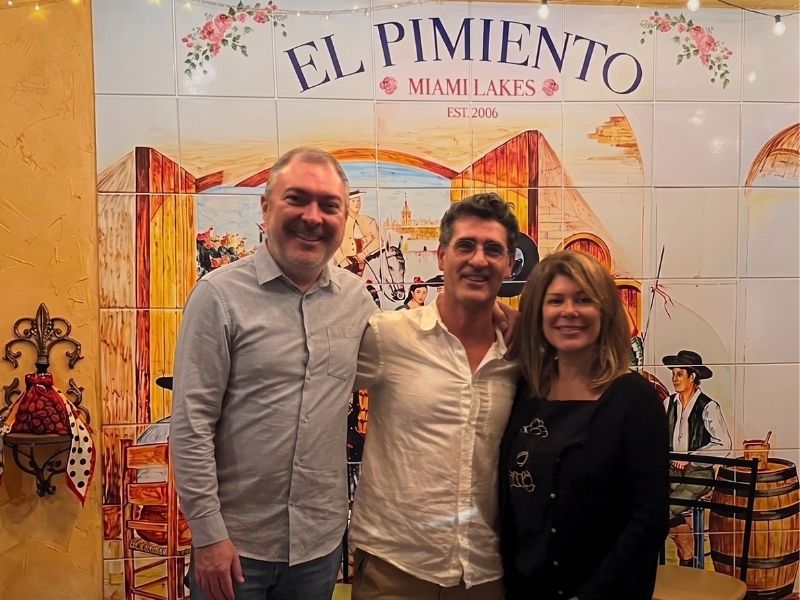
The canvas belongs to Iñigo Manterola, a Basque painter and sculptor who was showing his work at Art Miami with OMSA Gallery. Roberto Cavallini and Veruska Chalbaud went to the fair. They came back carrying a wrapped square under their arms. Days later, Manterola himself walked into El Pimiento Restaurant and hung it beside a row of hand-painted Spanish fans.
A painter from the harbour
Manterola was born in Orio, on the Basque coast, in 1973. He grew up in a family with a long fishing tradition, and the port shaped his eye early. Later, he studied Fine Arts in Bilbao between 1993 and 1998. Since then, his work has appeared in more than seventy solo and group exhibitions.
In 2019, he opened a large studio in Zarautz. He also keeps a gallery in San Sebastián. Moreover, he works in two languages at once: paintings full of movement, and sinuous sculptures in Corten steel. His subjects usually come from the sea. Fishing boats, arrantzales, the ordinary noise of the harbour.
Why a pepper, and why it looks like that
That is what makes this canvas unusual. A painter who has spent thirty years at the harbour chose, this time, to paint a vegetable. Not any vegetable, of course. He painted the red pepper that gives the restaurant its name.
Look closer, though. The pepper is not painted the way a still life usually is. Instead, Manterola built it from ribbons of red that loop and cross over a dark field. Those winding lines are his signature, and they run through his whole body of work. In fact, they are the same paths that later become his steel sculptures. As a result, the pepper reads as a portrait rather than a copy.
Two crafts, one raw material
There is a quiet symmetry here. Manterola paints what the Atlantic gives his village. Meanwhile, the kitchen cooks what the same waters give Spain. Both trades begin with something plain and turn it into something worth sitting down for.
Spanish cooking works exactly that way. A pepper, good oil, salt, fire. Nothing else. Furthermore, the discipline is identical in both cases: respect the ingredient, and never hide it.
Cavallini put it well in his own note about the visit. Great relationships, he wrote, often grow out of simple things.
Where Spanish art Miami visitors can actually sit down
The painting did not land on an empty surface. It joined fans, ceramic plates, a flamenco disc and objects gathered over nineteen years. Consequently, it did not interrupt anything. It simply entered a conversation that started in 2006.
That conversation reaches well beyond one dining room. Guests arrive from across Greater Miami. Some drive in from Hialeah, others from Doral or Hialeah Gardens. They come for tapas, for raciones, and for a kitchen that carries the Restaurants from Spain certification granted by ICEX.
Fairs close after a week. A wall does not. Therefore, this canvas gets something most pieces never do: a room full of people, every single night.
The pepper you can also eat
Here is the detail that closes the circle. One of the desserts on the table is a warm cheese tart served with pepper marmalade.
So the pepper hangs on the wall, and the pepper arrives at the end of the meal. Manterola painted it. The kitchen cooks it. Both versions came from the same idea, and neither one needed much explaining.
Come see it
The canvas hangs where anyone can see it. Book a table at El Pimiento Restaurant in Miami Lakes, and take a look at the wall before you leave.